
MLB Best Bets UK: Daily Picks & Bookmaker Odds
 Available in US
MLB best bets, decoded for UK punters.
MLB Betting Strategy for British Punters
The first MLB ticket I ever wrote down in a notebook was a moneyline on the Boston Red Sox at 1.91, placed at quarter past one in the morning from a kitchen table in Manchester. I won £18.20 on a tenner, slept four hours, and went into a meeting the next day looking mugged. That night taught me what the next ten years confirmed every season: MLB betting from the UK is a viable craft, and it punishes anyone who treats it like football.
You searched "best bet MLB" and the top results were American sites quoting prices in plus and minus, partnering with sportsbooks you cannot legally open in Birmingham. I have spent a decade building run-line models, scouting starting pitchers for value, and comparing UKGC-licensed books on actual margin rather than welcome-offer copy. This is the playbook I wish someone had handed me at that kitchen table.
By the end you will know how to read MLB prices in decimal, which three markets deserve your stake, how to build a daily routine that survives the GMT-to-Eastern gap, which UK bookmakers run the deepest baseball books, and how the 2025-2026 UKGC reform reshapes every promotion you see. A 162-game season, 2,430 regular-season fixtures, £6.9 billion of UK remote-betting yield behind every line, and a sport most of your friends will never quite understand. The edge is available. The question is whether you do the work.
£6.9bn
UK remote-betting GGY, April 2024 to March 2025
2,430
regular-season MLB games every year
~28%
of MLB games decided by a single run
18+
UKGC-licensed bookmakers only
Six lines before you bet a penny
- MLB betting is fully legal in the UK through any UKGC-licensed bookmaker — the 2025-2026 reform tightened the rules, it did not close the door.
- The three markets that matter are the moneyline, the run line at plus or minus 1.5, and the total — props are optional, accumulators are mostly for the book.
- Roughly 28 percent of MLB games end with a single-run margin, which is the entire reason the run line is the hardest spread in mainstream betting.
- Home underdogs in MLB 2025 won 45.9 percent of the time against 33.1 percent for road underdogs — the home-dog angle is a genuine long-term edge.
- A statutory 1.1 percent levy, a £150 affordability trigger and bonus wagering caps now sit between you and every UK MLB market; ignore them at your account's peril.
The UK betting market behind every MLB line
Every MLB price you see at a UK bookmaker sits inside a market that is, globally, enormous. UK remote-betting gross gambling yield came in at £6.9 billion for the year ending March 2025, with real-event betting at £2.4 billion. Football leads, racing follows, baseball sits well down the table. That buried position is where the opportunity hides.
Total UK gambling yield reached £15.6 billion in the most recent figures, with around 48 percent of British adults gambling in some form and sports betting accounting for 56.6 percent of online activity. In Q1 of 2025-2026, online betting was still growing 2 percent year on year to £1.49 billion even as real-event volume dipped 9 percent under new compliance pressure. You operate inside a heavily regulated, financially healthy market where operators compete hard on football and racing, treat baseball as a thin-margin curiosity, and price MLB accordingly.
When an operator's main risk book is the Premier League and Cheltenham, the trader watching MLB closing lines at three in the morning has fewer eyes on the price. Soft spots open. They do not stay open long, but they exist disproportionately in markets the mainstream UK bettor ignores.
The £9 billion online figure. The wider UK online-gambling market hit USD 9.0 billion in 2025, projected to reach USD 13.2 billion by 2034 at a 4.21 percent compound rate. Globally, sports betting was valued at USD 108.92 billion in 2024 and is projected to nearly double to USD 198.53 billion by 2030.
Through Wave 3 of the Gambling Survey for Great Britain — July to October 2025 — exactly 8 percent of British adults reported placing an online bet on sport or racing in the previous four weeks. That figure has held steady for a year while regulatory weather shifted dramatically. Stable participation alongside record revenue means the basket per active bettor is growing — exactly the customer pattern the new affordability rules were written for.
You are not the marginal buyer the operator is chasing. You are the customer whose unit stake is large enough to matter and small enough to fly under the obvious risk thresholds.
Major League Baseball's UK foothold
I was at the 2024 London Series. Mets versus Phillies, June heat in Stratford, Tube absolutely heaving with families wearing Lindor and Bohm shirts. Two days, 108,956 spectators, and the bloke next to me — bricklayer from Romford, never seen a baseball game in his life — turning in the fourth inning to ask why the manager kept changing pitchers. That is MLB's UK foothold in microcosm: surprisingly large, genuinely curious, almost entirely untrained.

The 2023 edition with the Cubs and Cardinals produced an estimated £67 million economic impact for London, average attendance of 55,000 per game, and a remarkable 71 percent UK fans in the crowd. MLB's UK social channels grew 133 percent in a single year and merchandise sales in Britain climbed 43 percent over the same window. The pump is being primed.
MLB's UK strategy, on the record. Chief Operations and Strategy Officer Chris Marinak put it plainly in 2024: the UK has been clearly identified as a priority market and an area for international growth emphasis. That is league-office speak for "we will keep showing up." London Series cancellations notwithstanding, the merchandising, broadcasting and licensing infrastructure keeps building in the background.
The 2026 London Series — Yankees and Blue Jays, scheduled for 13 and 14 June — was cancelled because of scheduling conflicts with West Ham United at the London Stadium. That hurt. The series had become the one tentpole event where casual UK fans got a real-time on-ramp to the sport, and where UK bookmakers spiked their MLB handle for a forty-eight-hour window.
The London Stadium baseball configuration is worth knowing if you ever bet a London Series game. Capacity of 55,000 to 60,000, foul poles at 330 feet — about 100.6 metres — and a centre-field measurement of 385 feet. Short foul poles and FieldTurf push offence up. When the series returns, those dimensions will move the totals line meaningfully.
Domestic baseball in Britain is also growing in a way most punters never see. The British Baseball Federation registered 105 teams in the 2025 domestic season — a record — and ended the year with 208 registered umpires. What that produces is a thicker layer of UK-based baseball literacy.
Reading MLB prices in decimal, fractional and American
Open any US baseball preview and the prices look like phone numbers. Yankees -150, Red Sox +130, total at 8.5 with -110 on each side. The first time you see it, the format does not feel like a price — it feels like a parking ticket. The same matchup at any UK bookmaker reads cleanly: Yankees 1.67, Red Sox 2.30, over 8.5 at 1.91. Same fixture, three formats — and moving between them in your head is the most useful unglamorous skill in MLB betting from the UK.
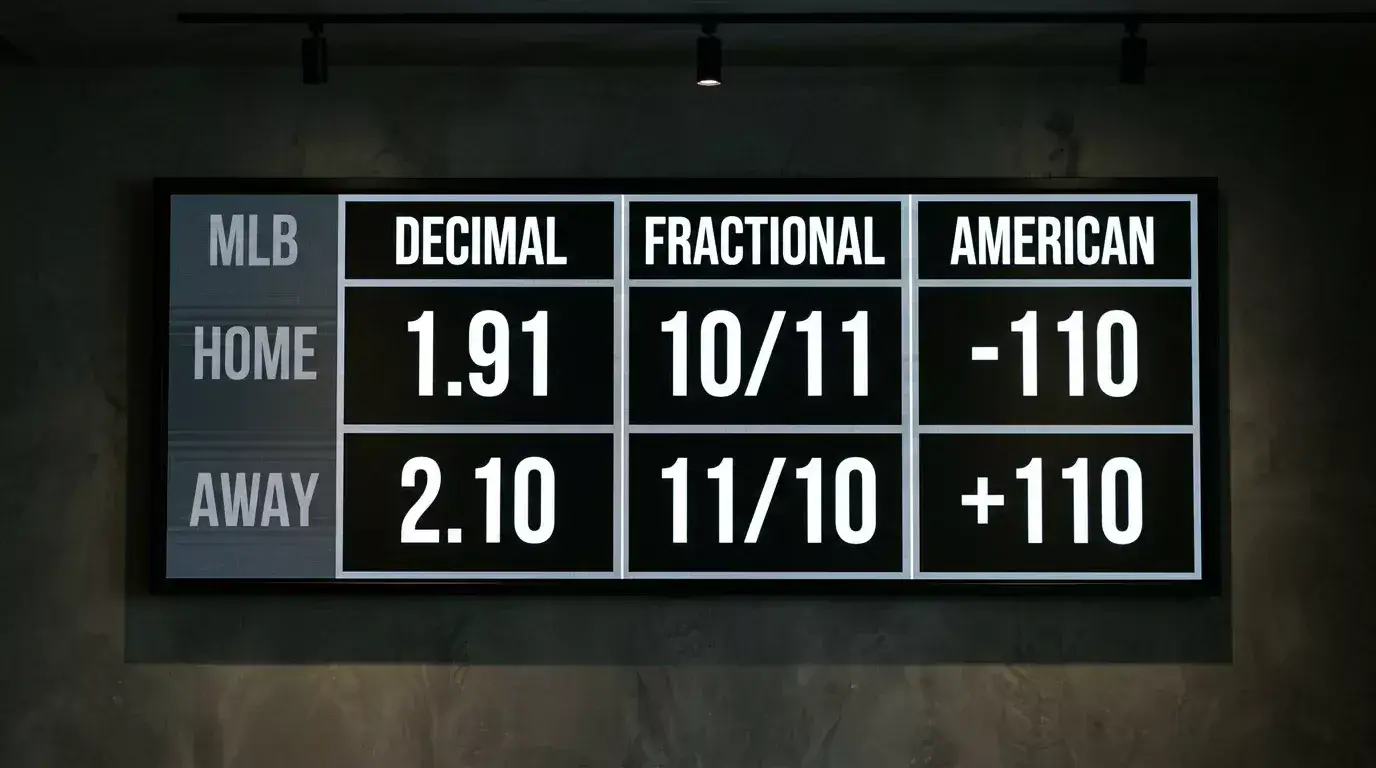
UK bookmakers default to decimal or fractional, and most allow you to switch in account settings. Decimal is the format I work in for everything quantitative. The number represents what you get back from a one-unit stake including stake — a 1.91 price returns £1.91 on a £1 winning bet. To convert decimal odds into implied probability, divide one by the decimal price. A 1.91 line implies 52.4 percent, before adjusting for the bookmaker's vig. That single piece of arithmetic underpins every value judgement you will make.
One price, three formats.
American: -150
Decimal: 1.67
Fractional: 4/6 or 2/3
Implied probability: 60.0%
American minus prices — favourites — convert to decimal by dividing 100 by the absolute value, then adding 1: -150 becomes 100/150 + 1 = 1.67. Plus prices — underdogs — divide by 100, then add 1: +130 becomes 130/100 + 1 = 2.30. Fractional is just decimal-minus-one as a fraction.
Vig — also juice, overround or margin. The bookmaker's built-in profit slice. On a typical MLB moneyline the two-sided prices add up to slightly more than 100 percent implied probability, with the excess being the operator's edge. Standard MLB vig at sharp UK books runs 4 to 6 percent on main markets, rising to 8 to 12 percent on props.
The same fixture can be priced at 1.91 in one UK book and 1.95 in another. On a £100 stake it is the difference between £91 and £95 profit. Across 200 bets at flat stakes, the gap between average and sharpest UK book on MLB sits between 3 and 6 percent ROI. Even money — 2.00 — is 1/1 fractional and +100 American, implying 50 percent. Internalise that boundary and conversion becomes muscle memory within a fortnight.
The three core MLB markets: moneyline, run line, totals
If you bet five MLB games next Tuesday and four are accumulators or same-game parlays, you have already lost the war. The three core markets — moneyline, run line and total — produce roughly 80 percent of the long-term edge available to a disciplined punter. The other 20 percent gets eaten by margin compounding on exotic stuff.
The moneyline
The moneyline is the simplest market: pick the winner. No handicap, no spread. Tied games do not occur in MLB regular-season play — extra innings continue until someone breaks the tie.
The catch is the price. MLB favourites are rarely heavy: average favourite prices hover between 1.55 and 1.75 decimal, and a road dog in a meaningful spot can drift to 2.40 or further. Long-term studies show MLB favourites win roughly 56 to 57.5 percent of regular-season games, with underdogs around 44 percent. Backing every favourite blind is a losing proposition because the vig more than eats the win-rate edge.
Where moneyline value lives. Historical edge clusters in home underdogs. The 2025 regular season was an extreme case — home underdogs won 45.9 percent of their games versus 33.1 percent for road underdogs. That gap is structural, not seasonal noise.
The run line
The run line is baseball's spread, fixed at plus or minus 1.5 runs. The favourite must win by 2 or more for a -1.5 ticket to cash; the underdog can lose by 1, draw, or win outright and a +1.5 still cashes. That simple description hides what is genuinely the hardest mainstream betting market in any sport.
Roughly 28 percent of all MLB games end with a one-run margin — a stable feature of the sport. A favourite priced at -200 on the moneyline might drift to +130 on the run line because that one-run cushion is the most important number in baseball. The full mechanics and 2025 team cover rates — Mets at 85.7 percent, Mariners at 80 percent against the spread — are unpacked in the run line cluster.
The total
The total — over/under — asks how many combined runs the two teams will score, with the bookmaker setting the line at roughly equal odds either side. Standard MLB totals fall between 7 and 10, with league average around 8.5 runs per game.
The total is the most input-sensitive of the three. Starting pitchers move it more than anything else, but park dimensions, wind, temperature, humidity and umpire strike-zone tendencies all leave fingerprints. A 9.5 at Coors in mid-summer with a breeze to right is fundamentally different from 9.5 at Oracle on a cold marine-layer evening.
Three markets, three different pricing logics — but every one routes back to the same question: who is on the mound?
Pitching, parks and weather: where the edge lives
Ask me which single number tells you the most about an MLB price and I will not say ERA, win-loss record, or recent form. I will say the starting pitcher's strikeout rate against the opposing lineup. Pitching prices the market before the first batter steps in, and the bettors who internalise this most quickly are the ones who survive their first full season.

ERA is the stat casual fans know and professional MLB traders trust least. It describes what happened — runs scored on a pitcher's watch — including massive contributions from defence, sequencing luck and which batted balls found gloves. A 4.10 ERA built on a 30 percent K-rate and 5 percent walks is better pitching than a 3.20 ERA built on a 6.50 walk rate and 14 percent strikeouts.
SIERA — Skill-Interactive ERA. A predictive pitching stat accounting for strikeout rate, walk rate, ground-ball tendency and batted-ball type, while filtering random sequencing. More stable than ERA across short samples and the best public predictor of near-term run-prevention.
K% / BB% — strikeout rate and walk rate as percentages of total batters faced. Both stabilise faster than any other inputs in the box. A K-BB gap of 18 percentage points or more is a strong pitcher signal regardless of ERA.
The pitcher-handedness split is where casual and prepared bettors diverge most sharply. Most hitters perform measurably better against opposite-handed pitchers. A team stacking left-handed bats facing an unproven southpaw carries a hidden disadvantage that does not show up in headline OPS. The full quantitative read is in the pitcher matchup analysis cluster.
Park factors compress and expand totals. Coors Field in Denver inflates run scoring at roughly 1.2 to 1.3 times league baseline thanks to altitude. Oracle Park suppresses it. Target Field runs about 7th best for offence over recent samples. None of this is fixed — humidity, temperature and wind shift local effect month to month.
Weather is the most underrated input I encounter with newer bettors. Wind out to right at Wrigley Field in July with humidity above 70 percent turns a 9.5 into something closer to a fair 10.5. The same matchup with wind blowing in at 12 mph and a cold front gets you a true 8.5. Books adjust for the headline forecast but lag the morning update.
Bullpen quality is the hidden multiplier on every full-game total. A starter pitching to a 3.40 SIERA can look pedestrian behind a poor bullpen. A mediocre starter behind a top-three bullpen routinely outperforms his peripherals. This is why first-five-innings markets — F5 in trader shorthand — isolate the matchup you scouted and remove the bullpen.
DiamondEdge model · F5 vs full game
The Bullpen Tax
A full-game price pays for nine innings of pitching — but you only handicapped the starter. This engine fits a Poisson run model to the de-vigged market line, then strips the relief innings back out to show what the first five are genuinely worth.
Full-game moneyline, decimal
Starting pitchers, SIERA
Bullpens, ERA over the last 30 days
Fair first-five line, three-way
About 5.0 points of the home team’s full-game win probability is relief pitching rather than the starting matchup. If your read is on the mound, the full-game price is charging you for innings you did not handicap — the F5 market removes that charge.
Compare with your book
Comfortably above model fair value. Log the price, then re-run it once both lineups are confirmed — a rest day for a regular can move this line on its own.
Method: innings 1–5 charged to the starters, innings 6–9 to the bullpens against a 4.10 ERA league baseline. Run scoring is modelled as Poisson and the offensive term is calibrated so the model reproduces the de-vigged full-game price you entered, which keeps the F5 output on the same scale as the market. Extra-inning ties are split evenly. Estimates for research only, not betting advice. 18+, please bet responsibly.
A repeatable daily MLB betting workflow
The fastest way to lose money on MLB betting from the UK is to wait until 11pm, scroll the next morning's slate after three glasses of wine, and decide on a hunch. The fastest way to make money — slowly — is to build a routine. Six fixed touchpoints across a day, none more than twenty minutes, with bet placement as the final step rather than the first. A 162-game season rewards discipline above almost any other input.

My day is built around the GMT-to-Eastern gap rather than against it. East Coast games start at midnight or 00:30 BST in summer, and 19:00 or 19:30 GMT in winter. West Coast games drift to 03:00 BST or later. Day games start in late afternoon UK time. The full six-hour breakdown is in the daily strategy cluster; what follows here is the seven-point pre-bet checklist at its heart.
The seven-point MLB pre-bet checklist
- Starting pitcher confirmed by official team announcement — not rumour, not "TBD"
- Opposing lineup confirmed and checked for platoon-relevant injuries or rest days
- Weather verified within two hours of first pitch: wind, temperature, humidity, precipitation
- Ballpark factor cross-checked against the venue — especially for any totals position
- Opening line versus current line noted — sharp movement is a tell, not a deterrent on its own
- Price compared across at least three UKGC-licensed bookmakers
- Stake sized within your unit plan, with the bet logged before confirmation
The lineup-confirmation step is the one casual bettors skip and professionals refuse to bypass. MLB clubs routinely sit a star bat for a planned rest day, and that rest day can shift a fair total by a third of a run. Live lineups for evening East Coast games typically post 14:00 to 17:00 GMT.
Line shopping is where the lazy bettor donates 3 to 6 percent of annual ROI to the market. Holding accounts at three UK bookmakers captures most of the available spread on standard markets. Each book has its own pricing identity.
Bet sizing is where most punters get hurt. The temptation to "size up because this one is obvious" is the most expensive bias I have watched bettors talk themselves into. Flat staking — the same unit on every play — is the boring solution that wins. Variable staking only earns its place once you have a tracked record of 200-plus bets with positive closing line value.
A routine that takes twenty minutes a day, repeated for a 162-game season, is worth more than any single piece of analysis you will ever do. The discipline of the checklist is the edge — the picks are just the output.
Choosing a UKGC-licensed bookmaker for MLB
I have held UK accounts at every major UKGC-licensed bookmaker that prices MLB consistently. They are not interchangeable. Each book has a personality on baseball — a market it prices tight, a market it prices loose. Choosing two or three accounts is not about which welcome offer flashes loudest. It is about which combination gives the best price across the markets you actually bet.

The first question is the licence. A UKGC-licensed bookmaker operates under the Gambling Commission's framework — rules on safer gambling, advertising, customer protection, and since April 2025 the statutory 1.1 percent levy. Andrew Rhodes, the Commission's chief executive, has been blunt: if it suspends or revokes a licence, the operator's activity ceases immediately. That is the floor of consumer protection you are buying. Offshore "international" books advertising to UK punters do not offer it, and disputes with them are functionally unenforceable.
Sports betting share. Sports betting accounts for 56.6 percent of UK online-gambling activity, with the UK online market valued at USD 9.0 billion in 2025. That growth pressure is why competitive UK bookmakers keep building out baseball books.
What "best" actually means
"Best UK bookmaker for MLB" is not a single league table. It is four overlapping questions: how tight is the moneyline margin, how deep is the prop menu, how fast does the live market update, and how aggressively does the book limit a winning customer.
The overround — the sum of implied probabilities on both sides of a market — is the cleanest comparable metric. On a typical MLB moneyline the sharpest UK book runs 103 to 104 percent. Mid-market books sit at 105 to 107. Recreational books run 108 or higher. On £100 stakes across 200 games, the gap between 103 and 108 percent is roughly £100 of EV — for free.
The roster of who actually books MLB in the UK
The major UKGC-licensed bookmakers that price the full MLB slate include bet365, William Hill, Sky Bet, Ladbrokes, Paddy Power, Coral, LiveScore Bet, BoyleSports and Unibet. The standout exchange is Betfair Exchange, which operates on different mechanics. Some price every starting pitcher's strikeout total nightly; others post props only on marquee matchups.
I am deliberately not ranking them. The practical workflow involves holding accounts at three UK books from three different parent groups, because consolidated ownership tends to mean similar pricing. The market-by-market breakdown is in the UKGC-licensed bookmaker comparison.
Do
- Hold accounts at three UKGC-licensed books from different parent groups
- Verify each book's MLB market depth before depositing
- Use Betfair Exchange for line-shopping reference even if you do not bet there
Don't
- Bet at any operator without verifying its UKGC licence number
- Chase welcome offers from books with poor MLB market depth
- Use offshore "international" books that advertise to UK punters
One pattern worth knowing: UK bookmakers limit MLB winning accounts more slowly than football or racing winners, because baseball is not their primary risk concern. That is a structural advantage for the patient MLB-only bettor.
Watching MLB from the UK: time zones and broadcasts
You cannot trade what you cannot see — at least, not reliably. The biggest practical question for a UK MLB bettor in 2026 is how to actually watch the games you have money on, and the answer changed materially when HBO Max bundled TNT Sports access from March 2026. There are now three legitimate routes, each with a different trade-off between completeness and convenience.
MLB.TV
MLB.TV remains the gold standard for a UK bettor. The full-season package runs at £119.99 a year, with a single-team option at £103.99. The structural advantage over US viewers is no local blackouts — every game, every night, with both home and away broadcasts. For a punter who bets multiple games per night, that completeness is non-negotiable.
The interface gives you live box scores, pitch-by-pitch breakdowns and Statcast overlays on demand. If your bet hinges on a starting pitcher's velocity holding through the fourth, you can verify in real time.
TNT Sports
TNT Sports holds the MLB UK broadcasting rights for marquee games and select weekly fixtures. The cheapest standalone plan runs at £25.99 a month on a 12-month contract, and from 26 March 2026 the equivalent access bundles into HBO Max. TNT shows curated games rather than the full slate, so it is a complementary subscription rather than a replacement.
For the casual UK fan dipping into MLB around the playoffs and World Series, TNT is the more sensible single-product choice. For a working bettor placing thirty or forty bets a month, MLB.TV remains the primary tool.
Time zones, plainly
East Coast night games typically start at 00:00 to 00:30 BST and run to around 03:30. West Coast night games start at 03:00 BST and can run until 06:30 or later. Day games start around 18:00 BST, the only family-friendly window.
The sleep cost is real. Most UK MLB bettors I know settle into a hybrid pattern: place bets in the evening UK time, sleep through the games, check the result in the morning. In-play liquidity from a UK book at 03:00 GMT is markedly thinner than the pre-game market. Do not chase live action you cannot watch alert.
Free options exist but are limited. MLB First Pitch shows the first inning of any selected game and switches off thereafter. YouTube carries condensed replays and highlights. For pure score-tracking, MLB Gameday on the app provides everything a bettor needs without video.
UK regulation 2025-2026: what changed for bettors
The 2025-2026 UKGC reform is the single biggest change to British gambling regulation in a decade, and every UK MLB bettor is now operating inside it. The reform stacks three coordinated interventions: a statutory levy, lowered affordability thresholds, and bonus-wagering caps with a mixed-product ban.
The statutory levy came into force on 6 April 2025. Online operators pay 1.1 percent of their GGY, land-based casino and betting pays 0.5 percent, and other categories pay 0.1 to 0.2 percent. In its first full cycle, the levy raised just under £120 million, ringfenced for research, prevention and treatment of gambling-related harms.
Why the levy exists. Baroness Fiona Twycross, the DCMS minister for gambling, summarised the rationale: the previous voluntary funding system was no longer fit for purpose, and the manifesto commitment to reduce gambling harms required a statutory mechanism.
For a UK MLB bettor, the levy affects nothing you can see directly. What you may notice is tighter operator margins on the marketing side — less generous welcome offers and tighter terms on price boosts. Operators are absorbing the levy mostly through promotional spend rather than worsened odds.
The affordability-check threshold dropped to £150 net deposits per month in February 2025 — the trigger for the Commission's light-touch financial vulnerability check, open-source data only. The enhanced check, which can require pay slips or bank statements, has a higher trigger but is applied earlier in suspicious patterns. A serious UK MLB bettor placing twenty or thirty bets a month at £20 stakes will hit £150 in their first or second month.
The bonus wagering caps and the mixed-product ban came into force in January 2026. The cap limits how aggressive a free-bet promotion can be on rollover. The ban prohibits offers that require wagering across multiple product types. For an MLB-only bettor that ban is a quiet positive: baseball promotions cannot drag you into higher-risk casino products as a wagering condition.
Adjacent context: slot stake limits. The same wave introduced a £5 per game-cycle cap on online slots for players aged 25 and over, and £2 for 18 to 24, effective April to May 2025. Baroness Twycross's stated concern was that online slots are the highest-risk gambling product — slot yield had grown 61 percent in the preceding five years.
The numbers driving the reform matter. The Gambling Survey for Great Britain Year 2 figures put the adult PGSI rate at 2.7 percent, stable. The 18-to-24 cohort runs materially higher: 21.9 percent scored 1 to 27 on the PGSI scale, and 5.3 percent scored 8 to 27, the severe category. The 76 percent mobile-gambling penetration in that age band is precisely the demographic the new rules are written to protect.
The reform's full operational impact on MLB betting — £150 trigger mechanics, documentation, appeals — lives in the UKGC rules cluster. The reform is real and sits behind every UK MLB market you bet.
Integrity in 2026: the micro-bet cap and what it means
I remember reading the wire on 5 November 2025 and knowing the MLB betting market had just changed permanently. A grand jury in the Eastern District of New York had indicted Cleveland Guardians relievers Emmanuel Clase and Luis Ortiz on charges of wire fraud conspiracy, conspiracy to influence sporting events through bribery, and money laundering conspiracy. The mechanism was pitch-level micro-betting: prop markets on individual pitches, allegedly manipulated for profit. The immediate question for a UK punter was whether your favourite markets had just become illegal, suspect, or both.
The response was swift. On 10 November 2025, the league announced a $200 cap on pitch-level micro-bets and excluded them from parlay constructions altogether. Ohio Governor Mike DeWine welcomed the move publicly, framing it as MLB taking affirmative steps to protect integrity and reduce incentives for improper betting schemes. The cap is American in currency, but UK books mirror the substance through their own internal limits.
The case did not arrive in isolation. In June 2024, San Diego Padres infielder Tucupita Marcano received a lifetime ban for placing bets in excess of $150,000 on baseball — including bets on his own team. Four other players received year-long suspensions. In February 2025, MLB dismissed umpire Pat Hoberg for sharing a betting account. The integrity environment going into the 2025 World Series was already strained before Clase and Ortiz.
How the league framed it. Commissioner Rob Manfred used his World Series press scrum in October 2025 to make the league's position plain. He acknowledged that MLB had not asked for legalised sports betting — the environment had simply arrived, and the league now had to operate inside it. His stated priority is protecting integrity through monitoring systems and direct data-sharing with sportsbooks. The MLBPA's Tony Clark backed the cap on the record, noting the union had been concerned about prop bets from day one.
For a UK punter the practical implications are narrower than the headlines suggest. Pitch-level props have either disappeared from UK books or had their stake limits dramatically tightened. Live in-play micro-markets on individual at-bats now carry much smaller liquidity than a year ago. Standard game-level markets — moneyline, run line, total, full-game pitcher strikeout totals — remain entirely unaffected, and that is where the vast majority of disciplined UK MLB betting volume already lived.
What this means for your daily routine is straightforward. Stick to the main markets. Treat exotic micro-bets as the marketing products they are. Read MLB integrity news as part of your pre-bet preparation rather than tuning it out.
Bankroll, units and staking for a 162-game season
The 162-game regular season is the longest schedule in major North American sport, and the bettors who survive it size their bets for distance rather than adrenaline. 2,430 regular-season games means 15 to 20 fixtures every night through spring and summer. A punter who bets all of them at the same stake loses to compounding vig; a punter who bets two carefully selected fixtures a night at 1 percent of bankroll has the best long-term shot at finishing ahead.
Your unit is a fixed percentage of bankroll — typically 1 to 2 percent for flat staking, up to 3 percent for advanced bettors with proven edge. The percentage stays constant; the absolute pound value moves only when you rebase, at fixed checkpoints, monthly being conventional.
A 1 percent unit on a £200 bankroll across an MLB season
Starting bankroll: £200
Unit size: 1 percent = £2 per bet
Monthly volume: 60 bets at £2 = £120 of action
Target ROI: 3 to 5 percent on closing line value
Expected monthly profit at 4 percent ROI: £4.80
Annual projection: £4.80 × 6 active months = £28.80
The numbers above are deliberately modest. A £200 bankroll producing £28.80 across a season is what serious recreational MLB betting from the UK looks like with honest maths. Scale linearly: a £2,000 bankroll at the same unit produces £288.
Flat staking is the recommended starting structure for any first full season. Kelly criterion scales each stake to the size of your perceived edge relative to the price. Full Kelly is mathematically optimal in theory and emotionally brutal in practice; most serious bettors run half-Kelly or quarter-Kelly to dampen variance.
Do
- Define your unit as a percentage of bankroll, not a fixed pound figure
- Rebase monthly at a fixed date, not after big wins or losses
- Track every bet — stake, price, market, result, closing line — in one sheet
- Use flat staking for at least 200 tracked bets before considering Kelly
- Segregate your MLB bankroll from football or racing bankrolls
Don't
- Increase stakes mid-month because you are confident in a particular night
- Chase losses by doubling stakes — that is how a season's edge evaporates in a week
- Bet money needed for rent, bills or other commitments
- Pool a single bankroll across casino, sports and accumulator play
The deepest pothole is psychological. The temptation to size up the bet you are most confident in is universal and almost always wrong. Confidence does not scale linearly with edge — it scales faster — and the bet you would happily put 5 percent behind is almost always a bet where your true edge is the same modest number it would be at flat stakes.
Affordability, GamStop and staying in control
Two seasons ago a friend of mine — a smart, financially comfortable, statistics-literate adult — phoned me at half past two in the morning to tell me he had just lost the family holiday fund on a six-leg MLB acca that needed Padres minus 1.5 in extras. He had not been planning to lose the holiday fund. He had been planning, at first, to wager a tenner. The escalation took four hours. Stories like that are why every section of this guide that talks about the price of a bet also has to talk about the price of not knowing when to stop.
The UKGC framework now includes mandatory deposit prompts, affordability checks at £150 net deposits per month, and integration with the GamStop self-exclusion scheme across every licensed operator. The 2.7 percent adult problem-gambling rate is the headline figure. The 21.9 percent of 18-to-24-year-olds scoring 1 to 27 on the PGSI scale is the headline that matters more. If you are in that age band, your statistical risk profile is materially higher than the population average regardless of how disciplined you feel.
What deposit limits actually do. Every UKGC-licensed bookmaker offers customer-set deposit, loss, session and wager limits. You set them in advance, and the operator must enforce them — they cannot be raised on a whim. A daily, weekly or monthly limit set below your current volume is the single most effective harm-prevention tool available. Cooling-off periods of 24 hours up to six weeks are available at every UK book.
GamStop is the UK-wide self-exclusion scheme that blocks access across every UKGC-licensed online gambling site. You register once, choose a period from six months up to five years, and every licensed operator must enforce the exclusion. GamStop blocks the entire gambling category — you cannot self-exclude from one sport and continue betting another. The framework is increasingly built around the operator's obligation to know its own customer rather than around blanket prohibitions.
MLB betting is a craft that rewards discipline and punishes urgency. If you are betting because you need the money, you will lose. If you are betting because you find genuine pleasure in the analysis and you can absorb 162-game variance without it affecting anything that matters in your life, you are the customer the framework is designed to serve. The line between those two states moves. Watch it.
For urgent support, BeGambleAware operates a free, confidential helpline and online resources 24 hours a day. Self-exclusion through GamStop is a structural tool; the helpline is the human one.
Frequently asked questions
Is MLB betting legal in the UK?
Yes — provided you bet through a UKGC-licensed bookmaker and you are 18 or over. Major UK books pricing MLB include bet365, William Hill, Sky Bet, Ladbrokes, Paddy Power, Coral, LiveScore Bet, BoyleSports, Unibet and the Betfair Exchange. The 2025-2026 reform tightened customer-protection rules but did not restrict baseball as a market.
What is a run line and how does it differ from the moneyline?
The moneyline is a straight bet on who wins, no handicap. The run line is baseball's spread, fixed at plus or minus 1.5 runs. A favourite at -1.5 must win by 2 or more; an underdog at +1.5 can lose by 1, draw or win outright. Roughly 28 percent of MLB games end with a one-run margin — the single most important number behind run line pricing.
What time do MLB games start in the UK?
East Coast night games typically start at 00:00 or 00:30 BST in summer and 19:00 or 19:30 GMT in winter. West Coast night games start at 03:00 BST or later. Day games — Wednesdays, Sundays and some Saturdays — start around 18:00 BST. Most UK punters bet pre-game in the evening and check results in the morning rather than trade live overnight.
Which UK bookmaker tends to offer the sharpest MLB prices?
No single UK book is sharpest across every MLB market every night — which is why holding three accounts at books from different parent groups is the standard structure. Sharpest moneyline pricing rotates between bet365, William Hill and the Betfair Exchange, each typically running 103 to 104 percent overround on standard matchups. The Exchange is uniquely placed because its prices are set by user supply and demand, making it the cleanest reference for fair value.
Can I bet on the MLB London Series and the World Series in the
UK?
Yes — both are among the most heavily traded MLB markets at UK books. The World Series is the deepest annual MLB market in the UK, with futures from spring training through to game-by-game postseason markets. The 2025 World Series — Toronto Blue Jays against the Los Angeles Dodgers — drew significant UK volume. The 2026 London Series between the Yankees and Blue Jays was cancelled over scheduling conflicts at the London Stadium, but the format is expected to return.
How does the 2025-2026 UKGC reform affect MLB betting
specifically?
The 1.1 percent statutory levy on online operators' GGY came into force on 6 April 2025 and raised just under £120 million in its first cycle, ringfenced for harm-prevention research and treatment. The affordability threshold dropped to £150 net deposits per month. Bonus wagering caps and the mixed-product ban took effect in January 2026. None of these rules ban MLB betting — they shape how operators acquire and retain customers around it.
Where to go next
Everything above is the playbook. Where you go from here depends on which part of MLB betting you want to deepen first.
This playbook is wide rather than deep on purpose — it covers the full surface of MLB betting from the UK in 2026, but each of the five core topics has its own dedicated guide where the maths and the workflows get the room they deserve. The run line cluster works through team-by-team 2025 cover rates. The daily strategy guide walks every step of the 24-hour cycle. The pitcher matchup cluster takes SIERA, xFIP and platoon splits from glossary to actionable signal. The bookmaker comparison covers what each major UK book does well on baseball. The UKGC rules guide unpacks the levy, affordability mechanics and bonus caps in operational detail.
The single most useful thing you can do tonight is open your tracking sheet, write down your unit size as a percentage of your bankroll, and commit to placing your first MLB bet of the next available game following the seven-point checklist. Not a different bet. Not a smarter bet. The same bet you would have made anyway, but with the routine attached. That is where the edge starts.
Related posts

MLB Betting and UK Tax: What Punters Actually Need to Know

MLB Public vs Sharp Money: Reading the Line Movement